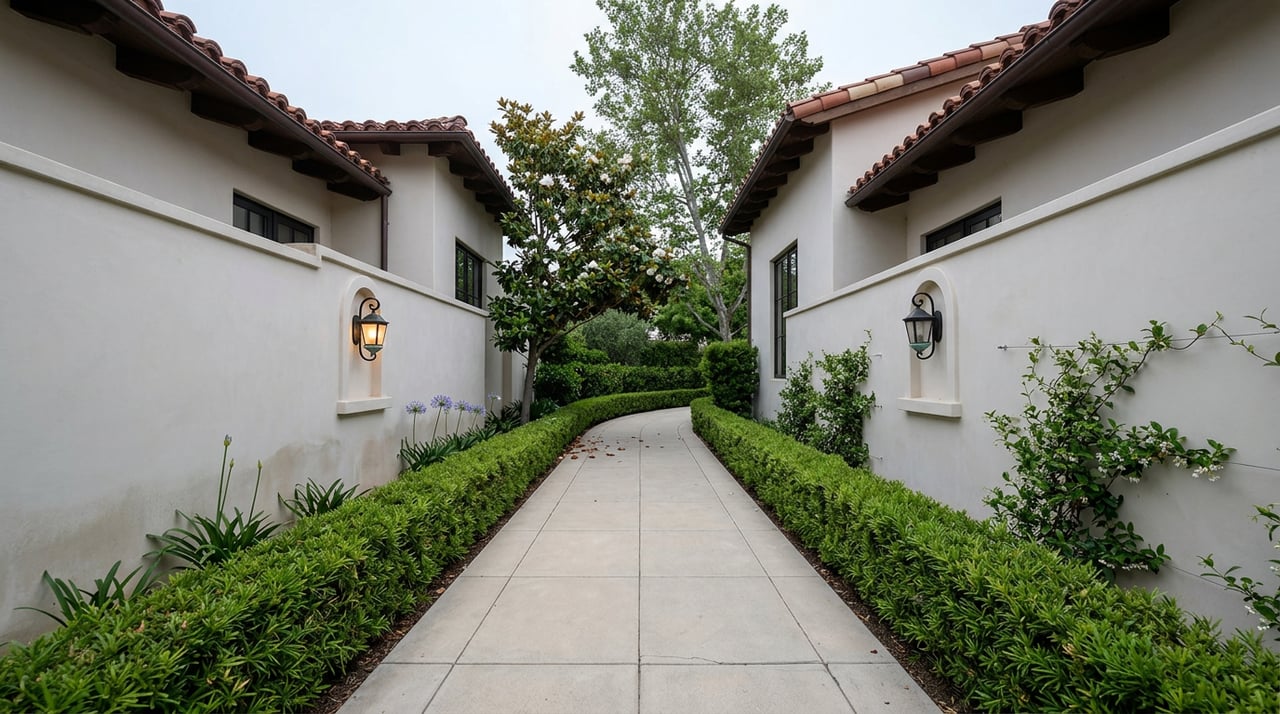
Walk out of almost any home in Eastwood Village on a weekday evening and you will not touch a street sidewalk for the first ten minutes. You will cross a paseo instead, one of the landscaped pedestrian lanes that thread behind the houses and connect straight to a park, the elementary school, or the underpass that ducks beneath Jeffrey Road into open space. Ask a resident how to get to the pool and they will describe a path, not a route with cross streets. That is not an accident of design. It is the entire premise of the village, and it explains something residents feel but rarely name: Eastwood is one of the most walkable places in Irvine for everything except the things you actually need to buy.
The Network Was Built for Trails, Not Errands
The paseo system is the first thing anyone notices once they stop driving everywhere out of habit. These are dedicated walking lanes, separate from the street grid, that link the village's neighborhoods to its parks, its school, and its trail access points without ever requiring a resident to walk along a road. The system culminates at a pedestrian underpass that carries walkers and cyclists beneath Jeffrey Road directly onto the Jeffrey Open Space Trail, a 3.5-mile route through Irvine's northern preserve, with a further connection out to Hicks Canyon Trail for anyone extending the loop.
The entrance to the village makes the intent obvious before you even reach a park. Eastwood was planted with more than 15,000 trees during construction, and the developer preserved a windrow of heritage eucalyptus from the original Irvine Ranch rather than clearing it. That windrow now shades Grand Trellis Park, anchored by an 80-foot silk floss tree that predates every house around it. It is the kind of landmark residents use as a meeting point without thinking twice, the neighborhood's version of "under the big tree."
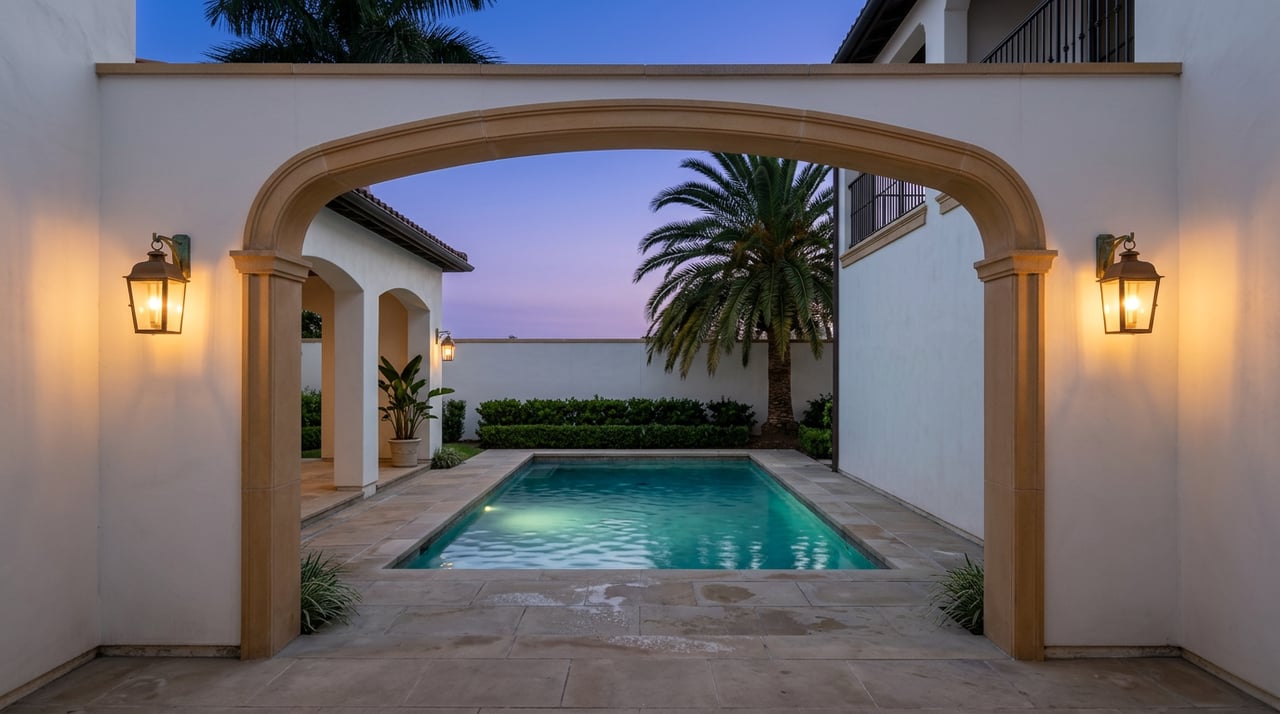
Keep walking the paseo network and it lets out at Eucalyptus Park, the village's actual recreation hub. It has a Junior Olympic pool, a separate wading pool, a spa with an ADA chair lift, half-court basketball, shade structures, picnic areas, and a club room residents can book for private events. None of it requires a car. Eastwood Neighborhood Park, a 6.13-acre park at 130 Frontier that opened in 2017, adds a baseball and softball field, a soccer field, lighted tennis courts, and a bicycle course, all reachable the same way. If your daily itinerary is recreation, Eastwood is close to frictionless.
What the Walk Score Actually Measures
Here is the number that gets flattened into marketing copy every time someone describes Eastwood as an "urban village": a Walk Score of 60, rated Somewhat Walkable, and a Bike Score of 74, rated Very Bikeable, as of a spring 2026 tally. Those two scores are not measuring the same kind of trip, and the gap between them tells you exactly what the paseo system is optimized for.
The bike score is high because the internal path network makes short recreational trips easy. The walk score is middling because the nearest grocery store, Woodbury Town Center, sits about a mile away with no direct pedestrian route along Irvine Boulevard. You can walk to the pool. You cannot easily walk to milk. The village's own layout draws a hard line between the paths that were engineered for community life and the arterial road that was not. Most residents solve this the same way, by driving the short distance to Woodbury Town Center for Pavilions, CVS, or a lunch at Mendocino Farms or Blaze Pizza, or by riding an e-bike, which has become common enough in Eastwood that it now reads as the village's unofficial second vehicle. For anything beyond that, the drive south to Irvine Spectrum for a wider mix of retail and restaurants is close but still a drive.
None of this makes Eastwood less livable. It makes it specific. The paseos were built to move people between homes, parks, school, and trailhead, not between homes and a shopping cart. Anyone who bought into the "walk everywhere" pitch without noticing that distinction eventually adjusts their week around it, usually within the first few months.
The School Sits Inside the Loop, Not Outside It
Eastwood Elementary sits at the physical center of the paseo network, which means the walk to school for most families is the same kind of car-free trip as the walk to the pool. The campus has built its identity around that access, pairing the walkable design with classrooms that lean into project-based learning, including a green-screen studio where students produce a weekly news show and a robotics program that runs alongside the standard curriculum.
"Teachers here are outside-the-box thinkers who bring opportunities to the kids and build excitement."
That is how the school's principal, Aaron Jetzer, described the campus in a profile for the Irvine Standard. The quote is a few years old now, but the structure it describes, a school built into the same path system as the parks around it, has not changed, and it is the reason drop-off in Eastwood looks less like a line of cars and more like a stream of families walking the same paseo they used the day before.
A Calendar That Runs on the Same Paths
The physical network gets its social counterpart from the Eastwood Civic Association, a volunteer group that programs the village's paseos and parks with a recurring calendar rather than a single annual event. Two anchor gatherings repeat every year: a Spring Fiesta in April and National Night Out in October, both free and open to residents across every ECA-represented neighborhood. Between those two, the association runs quarterly Coffee & Conversations meetups and periodic Park Playdates that use the same paths residents already walk for errands and school runs.
This year's version of that rhythm is already on the record. In late March, the ECA held its spring play date and Easter egg hunt at Eastwood Park, egg hunt starting promptly at 9:50 a.m. for kids 12 and under. In late April, residents gathered on the Park Drive esplanade, between Lockwood and Eddington, in place of the group's regular membership meeting. By late June, the group was back to its quarterly format with a Coffee & Conversations meetup, coffee provided, location rotating between a local park and a nearby coffee shop.
The next entry on that calendar is National Night Out this October, the association's second flagship event of the year and typically the best-attended gathering on the paseo network, since it deliberately spills residents out of their houses and into the shared paths after dark. If you have never been, it is worth checking the Eastwood Civic Association's own events page closer to the date, since exact times and locations get finalized only a few weeks out.
What ties all of this together is that the calendar and the concrete are the same infrastructure. The ECA is not importing programming into Eastwood so much as scheduling use of a network that was already built to carry foot traffic between homes, parks, and school. The paseos are the reason a Tuesday evening playdate at Grand Trellis Park feels like a five-minute stroll rather than a planned outing, and it is the reason National Night Out here tends to fill the paths rather than a single street.
Eastwood was built as a walking village with a specific, narrow definition of what walking is for. It moves you to your pool, your park, your school, and your trailhead without a car. It does not move you to your groceries. Both of those facts are true at once, and understanding which one applies to which errand is most of what it takes to live here without friction.
If you are weighing what any of this means for your own Eastwood home, whether it is the paseo access, the school, or simply what the village's layout does for resale interest, Jen Gong has spent years working Irvine's villages block by block and is glad to talk through it, starting with a free home valuation whenever you are curious what your place is worth in today's market.